
Lesson Plan: Democracy vs. Constitutional Republic – What’s Best for Entrepreneurs?

Grade Level: 9–12
Subject: Financial Literacy / Civics / Economics Class Length: 90 minutes Title: Personal Freedom, Property Rights, and Entrepreneurship in a Democracy vs. Constitutional Republic
🏛 Florida State Standards
SS.912.C.1.1 – Evaluate the impact of constitutional principles on the protection of individual rights.
SS.912.C.2.8 – Analyze current issues in terms of rights and responsibilities in a democratic society.
SS.912.E.1.2 – Explain how economic systems influence production and distribution.
SS.912.E.2.2 – Describe the roles of property rights, competition, and profit in a market economy.
SS.912.FL.1.1 – Explain how financial decisions are influenced by interest rates, inflation, and opportunity costs.
🎯 Learning Objectives
By the end of the lesson, students will:
Define Democracy and Constitutional Republic and explain their differences.
Analyze how each system affects personal freedom and business ownership.
Understand the 5th Amendment (Due Process & Just Compensation) and 14th Amendment (Equal Protection).
Evaluate the real-world impact of each system on entrepreneurship and private property.
Form and support an argument about which system is more beneficial for business owners.
📚 Materials Needed
Whiteboard or Smartboard
Handout: Constitutional Republic vs. Democracy Comparison Chart
Excerpts from the U.S. Constitution (5th & 14th Amendments)
Student worksheets and reflection sheets
Case Study Cards (example scenarios under both systems)
📋 Lesson Breakdown
1. Hook & Discussion (10 min)
Question to Students:
“Should 51% of voters be allowed to take your business and give it to someone else if they think it’s unfair you make more money?”
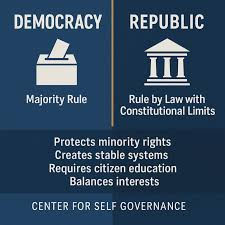
Discuss majority rule versus rule of law. Introduce the key difference:
Democracy = majority rule, decisions change with public mood
Constitutional Republic = rule of law limits majority power and protects individual rights
2. Direct Instruction: Key Concepts (20 min)
Comparison Table:
Feature | Democracy | Constitutional Republic |
Governing Power | Majority Rule | Elected Representatives + Law |
Rights Protection | Can shift with majority opinion | Guaranteed by Constitution |
Business Environment | Unstable, subject to sudden change | Protected by law and due process |
Risk to Entrepreneurs | High | Lower due to legal protections |
Amendments Overview:
5th Amendment: Government must follow due process and provide just compensation for property.
14th Amendment: Extends protection and due process to the state level (equal protection clause).
Real-World Examples:
Democracy Pitfall: Venezuela’s populist votes led to expropriation of businesses.
Constitutional Republic: U.S. Supreme Court decisions have upheld contract and property rights even under public pressure (Lochner v. New York, Kelo v. City of New London).
3. Group Case Study Activity (25 min)
Students split into teams of 4–5 and analyze:
Democracy Scenario: Voters pass a law capping all business profits and redistributing excess earnings.
Republic Scenario: Same proposal struck down due to constitutional protection of property rights.
Student Tasks:
Analyze personal and business rights affected.
Determine whether due process or just compensation was upheld.
Discuss how the scenarios impact business planning and risk-taking.
Groups present summaries of their findings.
4. Independent Written Reflection (15 min)
Prompt:
"As a future business owner, would you prefer to operate under a Democracy or a Constitutional Republic? Why?"
Students must use at least 3 of the following terms:
Property Rights
Due Process
Eminent Domain
Just Compensation
Equal Protection
Economic Stability
5. Class Wrap-Up Discussion (10 min)
Review Key Questions:
What protects personal and business rights better?
Why is constitutional law more stable than majority opinion?
How do the 5th and 14th Amendments secure your future as an entrepreneur?
Core Takeaway:
A Democracy enables fast political change—but often at the cost of stability. A Constitutional Republic is designed to protect your rights and your business—regardless of shifting opinions.
✅ Assessment
Formative: Participation in case study groups
Summative: Quality and accuracy of written reflection using key vocabulary
🔁 Extension Ideas
Research Project: Investigate local eminent domain cases and whether just compensation was truly given.
Debate: Resolved: Constitutional Republics provide better conditions for long-term business success than Democracies.
Graphic Organizer: Students create a visual mind map showing how property rights, due process, and just compensation influence investment decisions.


Comments