
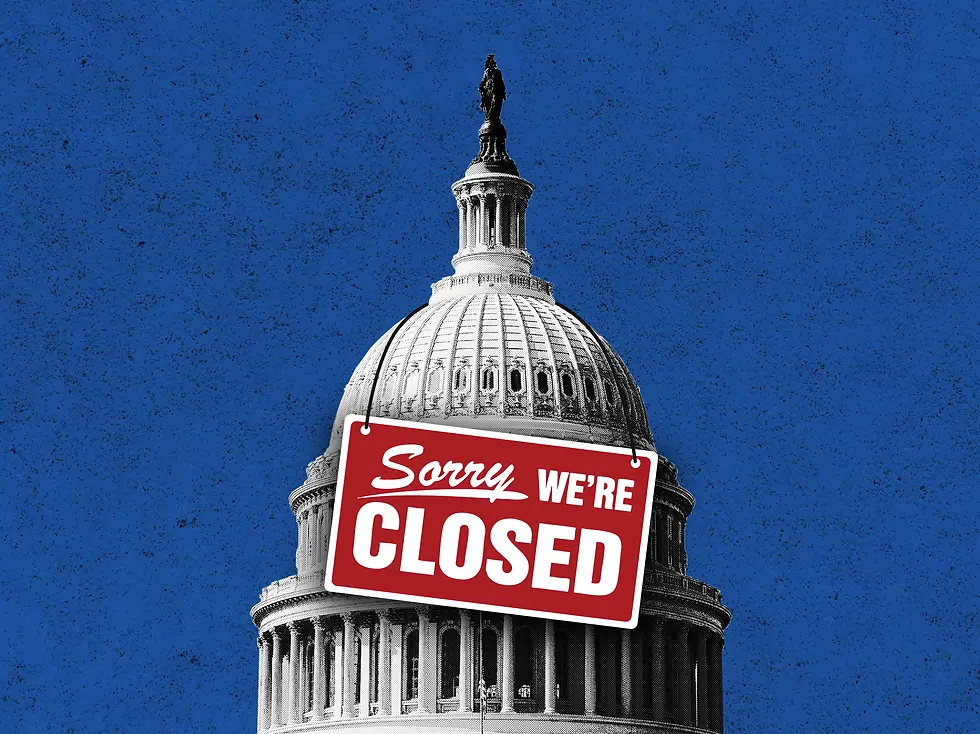
When Government Closes: Financial Impacts & Personal Strategy. The Schumer Shutdown.

Grade Level
9–12 (ideal for a Personal Finance or Financial Literacy course, or as a module in economics / civics)
Duration
One 50-minute class period (with optional extension into a second class)
Standards / Benchmarks (Florida / Sunshine State Standards)
From Florida’s Social Studies “Financial Literacy Strand”:
SS.912.FL.6.11 — Describe why an economic role for a government may exist
SS.912.FL.1.1 — Evaluate how values affect personal financial decision making
SS.912.FL.2.1 / 2.2 — Discuss income, tradeoffs, and future benefits of education/training
Because of Florida’s SB 1054 (Hukill Financial Literacy Act), high school students must complete a half-credit personal finance / financial literacy course prior to graduation.
Also, general financial literacy expectations (earning income, budgeting, risk, saving, credit, disruption) align with state expectations for a financial literacy course in Florida.
Note: The “Sunshine State Standards” were the earlier name; the modern regime is called the Next Generation Sunshine State Standards (NGSSS), and social studies, civics, and financial literacy standards are now integrated.
So this lesson addresses the state standard of understanding the government’s economic role and links it to personal financial decision making and disruptions.
Learning Objectives
By the end of class, students will be able to:
Explain what a federal government shutdown is and why it happens (appropriations, continuing resolutions).
Identify which federal functions continue (essential services) and which are suspended (nonessential, furloughed).
Analyze the financial impacts of a shutdown on federal workers, contractors, local economies, and public programs.
Apply those impacts to personal financial planning: how someone should prepare for income interruption or uncertainty.
Propose strategies (short-term and long-term) to mitigate personal financial risk in such situations (emergency funds, diversified income, buffer funds, budgeting, delaying discretionary payments).
Materials / Resources
Projector / slide deck
Student handout (definitions, data snippets, scenario worksheets)
News articles or summaries about the 2025 government shutdown (for context)
Whiteboard / chart paper
(Optional) Budget simulation or role-play packets
(Optional extension: “Federal Budget Simulation” resource)
Lesson Sequence
Time | Activity |
5 min | Bell Ringer / Hook: Show headline or brief article: “Shutdown Could Leave 750,000 Federal Workers Furloughed” Ask: “What happens if a large employer stops paying wages temporarily? What coping methods would you use?” |
8 min | Mini Lecture / Concept Introduction - What is a government shutdown? (failure of Congress to pass appropriations or continuing resolution) - Essential vs nonessential (who works without pay, who is furloughed) - Recent 2025 context: The government is projected to shut down at midnight, many agencies will furlough employees or cease nonessential operations |
7 min | Data & Impacts Share short data snapshots: • “The FAA would furlough 11,000 employees” • “41% of HHS workforce will be furloughed” • “Consumer Financial Protection Bureau continues work (not tied to CR funding)” • Discuss lost pay delays, local spending contraction, delayed services Have students annotate margins: “This affects what kinds of households?” |
10 min | Small-Group Scenario Activity Divide students into 3 groups. Each group receives a scenario of a person/household affected by the shutdown (for instance): – A federal employee furloughed – A contractor whose contract is canceled – A small business that relies on federal grants or funding Each group completes a worksheet: 1. What income sources are lost or delayed? 2. What fixed obligations (rent, car, loans) still must be met? 3. What short-term adjustments could they make? 4. What longer-term financial preparations could reduce risk? |
8 min | Group Reports & Class Discussion Each group shares key challenges and solutions. Teacher leads discussion: - Emphasize emergency savings, buffer funds - Diversification of income, side hustles - Communication with creditors, negotiating payments - Government back pay (in many shutdowns federal workers eventually receive back pay, though delays can create cash flow stress) - Role of policy: how predictable funding, automatic continuing resolutions, or stronger budgeting rules might reduce frequency of shutdowns |
7 min | Individual Reflection / Exit Ticket Prompt: “Given what we’ve learned, what is one change you could make (or plan) in your household finances to better handle an uncertain income shock? Why?” Collect responses or have students share one. |
5 min (stretch) | Extension / Homework Option Assign: Research how past shutdowns affected local economies or individual households (e.g. 2013 or 2018 shutdown). Write 1–2 paragraphs summarizing. Optional: Use “Federal Budget Simulation” to explore tradeoffs in federal spending. |
Differentiation / Extensions
Advanced students: Ask them to simulate proposing a policy to reduce the frequency or severity of shutdowns (e.g. automatic funding triggers, balanced budget rules).
Lower support group: Provide a graphic organizer or partially filled scenario for the small-group activity.
Cross-curricular tie-in: Combine with a civics lesson on the appropriations process (budget bills, continuing resolutions, Congressional oversight). Use the PBS “Shutting Down Government Shutdowns” lesson as a companion resource.
Assessment
Formative: Observation of group work and the discussion; exit tickets
Summative (optional): Ask students to write a short case study: “Imagine a 30-day shutdown occurs—outline a personal financial plan for a mid-career employee and a contract worker.” Evaluate on depth, realism, financial mitigation strategies, and understanding of government shutdown mechanics.
Teacher Tips / Notes
Be careful to keep political views neutral. Emphasize structures, incentives, tradeoffs, uncertainties.
Update data right before class—for example, new news on the unfolding shutdown.
Encourage students to think not only about immediate coping (cut discretionary spending) but also systemic resilience (emergency fund, diversified income).
If the shutdown actually takes place, use local or regional impacts (e.g. federal offices in your district) as class follow-up.
Sample Slide Outline / Key Points
Title & bell ringer
Definition of government shutdown / appropriations / continuing resolution
Essential vs nonessential functions
2025 shutdown forecast & impacted agencies
Financial impact on workers, contractors, local economy
Scenario worksheet instructions
Mitigation strategies / financial preparedness
Reflection prompt
Alignment to Standards & Rationale
The lesson addresses SS.912.FL.6.11 by engaging students in discussion about the role of government in the economy (funding, services, risk).
It also connects to behavioral finance aspects in Florida’s standards (SS.912.FL.1.*) by asking students how values and risk aversion influence their personal choices.
The income / tradeoffs standard (SS.912.FL.2.*) is invoked when students decide how to adjust budgets, prioritize fixed vs discretionary spending, and weigh future preparation.
The requirement for a personal finance / financial literacy course in Florida (via SB 1054) means that lessons like this help fulfill that curriculum in a timely, real-world context.
Potential Pitfalls & Mitigation
Students may feel anxiety if they or family members work for federal or state contractors — be ready for emotional responses.
Some may oversimplify solutions (“just cut everything”) — push them to think about balancing necessities, long-term rebuilding, and tradeoffs.
Avoid letting the class devolve into political debate; maintain focus on financial structures, behavior, and risk.
Time can run short in group work—provide clear timers or checkpoints.
Hashtags / Keywords for Sharing


Comments