
Pathways to Financial Freedom: Economic Systems & Forms of Government

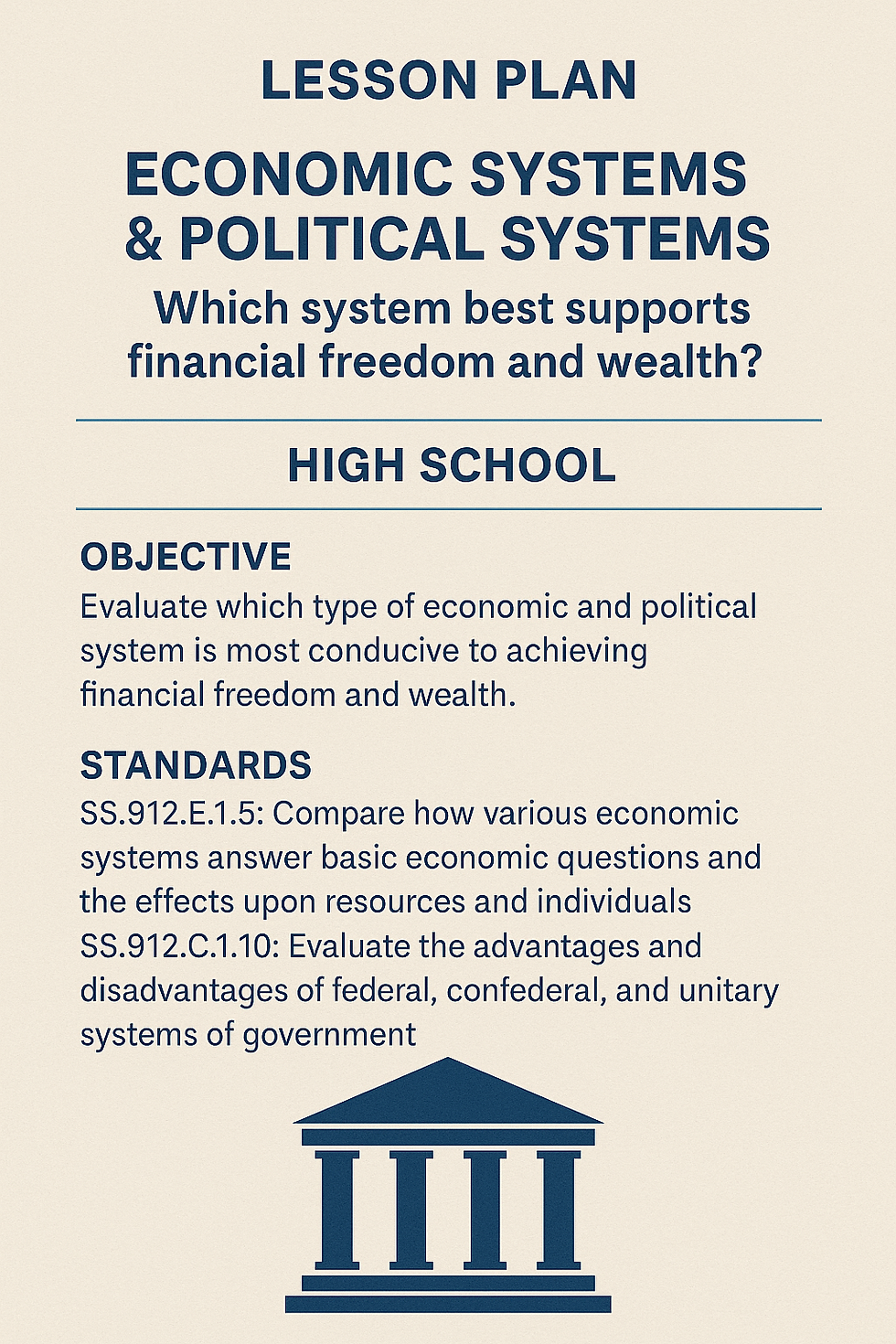
🎓 LESSON PLAN
Title: Pathways to Financial Freedom: Economic Systems & Forms of Government Grade Level: 11–12 Subjects: Personal Financial Literacy, Economics, U.S. Government / Civics Duration: 1–2 class periods (45–90 minutes total)
🧠 OBJECTIVES
By the end of this lesson, students will be able to:
Compare Communism, Socialism, and Capitalism as economic systems.
Analyze how these systems impact individual wealth-building opportunities.
Understand the differences between a Republic and a Democracy.
Connect how different systems and government types influence economic freedom and personal financial success.
Form and justify a personal opinion on which system is best for achieving financial freedom.
📜 FLORIDA STATE STANDARDS ALIGNMENT
🏛 Civics and Government:
SS.7.C.3.1: Compare different forms of government (direct democracy, representative democracy, socialism, communism, monarchy, oligarchy, autocracy).
SS.7.C.3.3: Illustrate the structure and function of government in the United States as defined by the Constitution.
💰 Personal Financial Literacy:
Standard 3.0: Identify sources of income such as wages, salaries, and commissions.
Standard 4.0: Understand the relationship between career choices, education, and income potential.
Standard 9.0: Describe how economic conditions and government policies influence personal financial decisions.
📚 MATERIALS
Whiteboard or projector
Student handouts (comparison chart, economic systems summary)
Constitution excerpts defining “Republic”
Videos or articles on types of economies and governments
Opinion writing worksheet
📝 LESSON OUTLINE
Warm-Up (10 minutes):
Ask: “If you wanted to become wealthy and financially free, which country would you live in — and why?” Students briefly journal their thoughts.
Part 1 – Economic Systems (20 minutes):
Direct Instruction: Define Communism, Socialism, and Capitalism.
Compare & Contrast:
Who controls the means of production?
How are wages, property, and profits treated?
What opportunities exist for personal wealth creation?
Class Discussion:
What is the role of government in each system?
Can people become rich in all three? Why or why not?
Part 2 – Forms of Government (20 minutes):
Explain: The U.S. is a Constitutional Republic, not a pure Democracy.
Review:
Republic = rule of law, protection of individual rights, elected representatives
Democracy = majority rule, more susceptible to mob rule if unchecked
Critical Thinking: How does the type of government affect economic policies and individual freedom?
Part 3 – Case Studies & Scenarios (15 minutes):
Provide examples of:
Entrepreneurs in capitalist nations
Government takeovers in socialist/communist countries
Economic stagnation under centralized control
Part 4 – Student Reflection & Opinion (20–30 minutes):
Prompt: Based on today’s lesson, in which system and government type would you have the best chance to build wealth and achieve financial freedom? Why?
Students write 2–3 paragraphs and share with a partner or group.
✅ ASSESSMENT
Completed comparison chart
Participation in discussion
Written opinion reflection with cited examples
Optional quiz on definitions and impacts of economic/government systems
🧠 EXTENSION ACTIVITY (Homework or Extra Credit)
Have students research one country that operates under each system and find:
GDP per capita
Unemployment rate
Tax rate
Percentage of citizens owning property or running businesses
📣 KEY TAKEAWAY:
Students should come away understanding that financial freedom is closely tied to economic and political systems — and that Capitalism within a Republic tends to offer the most opportunities for wealth-building and individual freedom.
🔖


Comments